Shastha Lift Carrier Private Limited
EST. 2009. 15 YEARS OF TRUST
EST. 2009. 15 YEARS OF TRUST

EST. 2009. 15 YEARS OF TRUST
Forklift Rental vs Buying: What's the Right Choice for Your Business in 2026?
Forklift Rental vs Buying: What's the Right Choice for Your Business in 2026?
Whether to rent or buy a forklift is one of the biggest equipment decisions a warehouse, manufacturing plant, or logistics operation makes — and it’s rarely as simple as “buying is always cheaper long-term.” The right answer depends on how consistently you need the equipment, how much capital you want tied up in machinery, and how quickly your operational needs might change. Here’s how to actually think it through.
The Case for Renting
Lower upfront cost. Renting requires no large capital outlay — you pay for usage, not ownership. This keeps working capital free for inventory, staffing, or other operational needs, which matters most for growing businesses or those managing tight cash flow.
Flexibility for fluctuating demand. If your material handling needs spike seasonally — festival season dispatch, year-end inventory pushes, a short-term project — renting lets you scale equipment up or down without being stuck owning machines that sit idle the rest of the year. Our fleet covers 1.5T to 10T capacity across Toyota and Godrej models, so you can match tonnage to the job rather than over-buying for peak demand.
No maintenance burden. Rental agreements typically include maintenance as part of the deal, meaning breakdowns, servicing, and upkeep aren’t your problem to manage or budget for separately.
Access to newer equipment. Rental fleets are often better maintained and more current than an owned forklift running past its optimal working life, since rental providers have a direct incentive to keep their machines in strong working condition.
The Case for Buying
Lower long-term cost for consistent, heavy use. If you’re running a forklift daily, multiple shifts, for years on end, ownership typically works out cheaper over the equipment’s working life than continuous rental payments.
No availability risk. Owned equipment is always there when you need it — no waiting on rental availability during your industry’s peak demand periods, when rental fleets are often stretched thin across multiple customers.
Asset value. A forklift is a depreciating asset, but it still holds resale value — particularly with a documented maintenance history (this is where a consistent AMC matters even for owned equipment).
Customization and familiarity. Owned equipment can be fitted with attachments specific to your operation, and your operators build long-term familiarity with the same machine’s quirks and handling.
The Real Deciding Factor: Usage Pattern
Most of the “rent vs buy” debate comes down to one question: is your forklift need constant, or does it fluctuate?
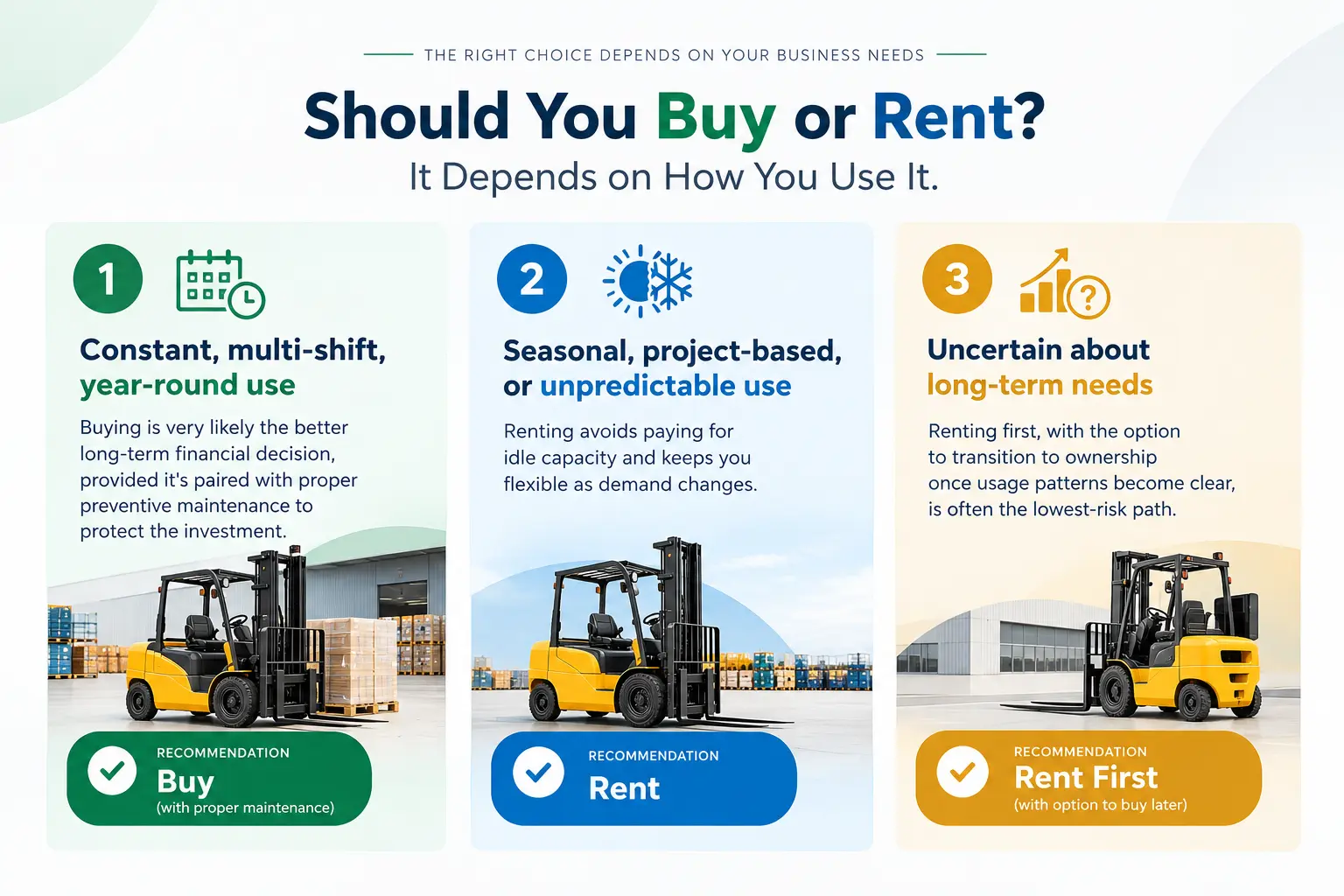
Whether you operate a single forklift in a small warehouse or a fleet of 20 machines across a large manufacturing facility, the service standard should never be compromised.
Book Your Forklift Repair & Service Today
Don’t wait for a breakdown to find a service provider. The best time to build a relationship with a reliable forklift repair company is before you need them urgently. Call us, WhatsApp us, or fill out our contact form — and a Shastha team member will get back to you within the hour during business hours.
A Middle Ground: Long-Term Rental
For operations that want predictable monthly costs without the capital commitment of buying outright, long-term rental agreements offer a middle path — often with maintenance bundled in, similar to ownership plus AMC, but without the upfront capital expense or resale-value risk.
What to Check Before Deciding Either Way
- Total cost over your realistic usage period, not just the sticker price of rental-per-month or purchase price
- Maintenance responsibility — who handles it, and what it costs if it's not included
- Brand and parts availability — multi-brand coverage (Toyota, Godrej, Jungheinrich, and others) matters more once something breaks and you need parts fast, whether rented or owned
- Operator familiarity — switching equipment frequently under short-term rentals has a training cost that's easy to overlook